Investing for beginners can seem complicated when you encounter terms such as stocks, bonds, ETFs, mutual funds, index funds, diversification, and compound interest. The good news is that you do not need to be an expert or have thousands of dollars to start learning about investing.
At its core, investing means putting money into assets with the goal of potentially increasing its value or generating income over time. Unlike keeping all of your money in a checking account, investing involves risk, including the possibility of losing some or all of your money.
For many beginners in the United States, a sensible starting point is to understand risk, time horizon, diversification, investment costs, and tax-advantaged accounts before choosing specific investments.
What Is Investing?
Investing is the process of using money to purchase assets that may increase in value or produce income over time.
Common investments include:
- Stocks – Ownership shares in publicly traded companies
- Bonds – Debt securities issued by governments, municipalities, and companies
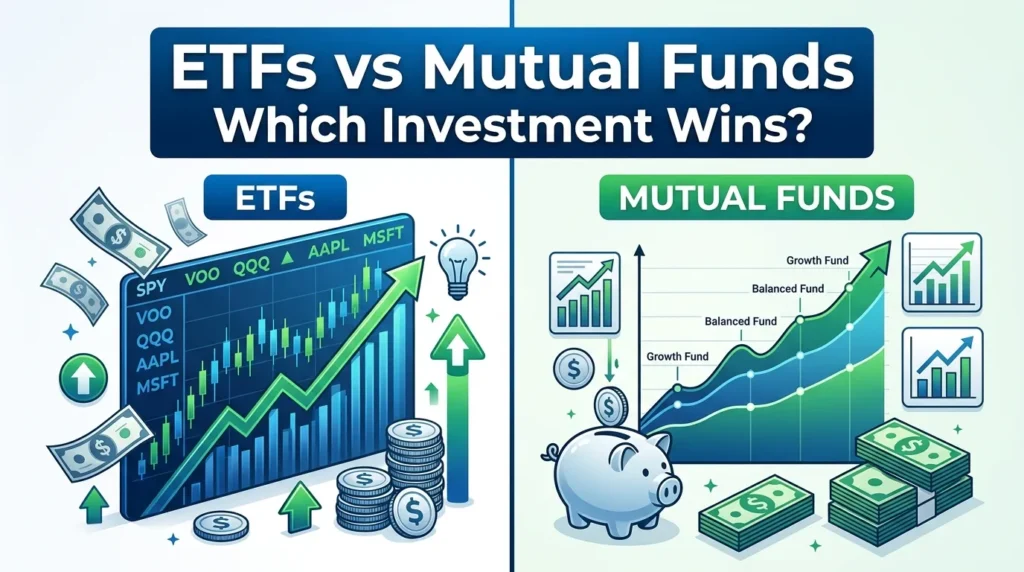
- ETFs – Funds that hold a collection of investments and trade on exchanges
- Mutual funds – Professionally managed pools of investments
- Index funds – Funds designed to track a particular market index
- Real estate – Property or investments related to real estate
- Treasury securities – Debt issued by the U.S. government
The important distinction between saving and investing is risk. Savings accounts and similar bank deposits can provide stability and may be protected by FDIC insurance within applicable limits. Investments such as stocks and stock funds are not FDIC-insured and can lose value.
How Should a Beginner Start Investing?
A beginner can start by creating a financial foundation before choosing investments.
A practical sequence is:
- Establish an emergency fund.
- Pay attention to high-interest debt.
- Determine your financial goals.
- Identify your investment time horizon.
- Understand your risk tolerance.
- Learn basic investment types.
- Choose an appropriate account.
- Build a diversified portfolio.
- Invest consistently.
- Review your strategy periodically.
You do not need to predict which stock will perform best next year. A long-term investing strategy generally focuses more on asset allocation, diversification, costs, taxes, and consistency.
Why Is Investing Important for Beginners?
Keeping money entirely in cash can create another risk: inflation.
Inflation reduces the purchasing power of money over time. If the prices of goods and services rise while your money earns little or no return, your savings may buy less in the future.
Investing provides an opportunity for long-term growth, although returns are never guaranteed.
For example, someone saving for retirement several decades away has a substantially different time horizon from someone saving for a home purchase in two years. The longer time horizon may allow an investor to tolerate more short-term market volatility, depending on their circumstances and risk tolerance.
Investing vs. Saving: What’s the Difference?
Saving generally focuses on preserving money and keeping it accessible. Investing focuses on potentially growing money over a longer period while accepting investment risk.
| Feature | Saving | Investing |
| Primary goal | Preserve money | Potential long-term growth |
| Risk | Generally lower | Varies by investment |
| Accessibility | Usually high | Depends on account and investment |
| Potential return | Generally lower | Potentially higher, but not guaranteed |
| Common examples | Savings account, CD | Stocks, ETFs, bonds |
| Best suited for | Short-term needs | Longer-term goals |
A beginner may need both. An emergency fund can provide liquidity, while long-term investments can potentially grow wealth.
How Much Money Do You Need to Start Investing?
There is no universal minimum amount required to begin investing.
Some brokerage accounts allow investors to purchase fractional shares of eligible securities, meaning you may be able to invest with a relatively small amount of money.
However, the more important question is not simply “How much can I invest?” but “How much can I invest without jeopardizing my essential financial needs?”
Before investing money needed for rent, mortgage payments, emergency expenses, or near-term obligations, consider building adequate cash reserves.
What Should Beginners Invest In?
There is no single investment that is appropriate for every beginner.
The right investment depends on factors such as:
- Financial goals
- Age and time horizon
- Risk tolerance
- Income
- Existing assets
- Tax situation
- Need for liquidity
- Investment knowledge
Many beginners learn about broad-market index funds and ETFs because they can provide exposure to many securities through a single investment.
For example, a fund tracking a broad stock-market index may hold shares of numerous companies. This can provide diversification compared with purchasing shares of only one company.
However, diversification does not eliminate investment risk. A diversified stock fund can still decline substantially during a market downturn.
What Are Stocks?
A stock represents an ownership interest in a company.
When you buy shares of a publicly traded company, you participate in the company’s potential gains and losses.
Stocks can generate returns through:
- Capital appreciation – The share price increases.
- Dividends – Some companies distribute part of their earnings to shareholders.
Stocks historically have offered significant long-term growth potential, but individual stocks can be highly volatile.
For beginners, purchasing individual companies requires research and an understanding that a single company can perform very differently from the overall market.
What Are Bonds?
A bond is generally a debt investment. When you purchase a bond, you are effectively lending money to an issuer such as a government or corporation.
Depending on the bond, the investor may receive interest payments and repayment of principal according to the bond’s terms.
Common categories include:
- U.S. Treasury securities
- Municipal bonds
- Corporate bonds
- Bond funds
Bonds carry different risks, including interest-rate risk, credit risk, inflation risk, and market risk.
What Are ETFs?
An exchange-traded fund (ETF) is an investment fund whose shares generally trade on a stock exchange.
An ETF may hold stocks, bonds, commodities, or other assets.
Beginners often encounter ETFs because they can offer:
- Diversification
- Convenient trading
- Exposure to a particular market or asset class
- Potentially relatively low expenses, depending on the fund
Not every ETF is diversified or low-cost, however. Investors should examine what a fund actually owns, its investment strategy, fees, and risks.
What Are Index Funds?
An index fund seeks to track the performance of a particular market index rather than attempting to outperform it through active security selection.
Examples of indexes include broad U.S. stock-market indexes and major large-company indexes.
Index investing is popular because it can provide broad market exposure and may have relatively low expenses.
However, index funds still carry market risk. If the underlying market declines, the value of the fund can decline as well.
What Is Diversification?
Diversification means spreading investments across different securities, companies, industries, geographic markets, or asset classes.
The basic idea is straightforward: concentrating all your money in one investment can expose you to the risk of that investment performing poorly.
For example, owning shares in 50 companies is generally less dependent on the performance of one company than owning shares in only one company.
Diversification does not guarantee profits or prevent losses, but it can reduce the impact that a single investment has on an overall portfolio.
What Is Asset Allocation?
Asset allocation describes how your portfolio is divided among different asset classes.
For example, a portfolio could contain combinations of:
- Stocks
- Bonds
- Cash or cash equivalents
- Other assets
The appropriate allocation depends on your goals, time horizon, and risk tolerance.
A person investing for a goal several decades away may have different asset-allocation considerations from someone who expects to need the money within a few years.
There is no universally correct stock-to-bond ratio for every investor.
Understanding Risk Tolerance
Risk tolerance refers to how much investment loss or volatility you can financially and emotionally withstand.
A common mistake among beginners is choosing investments based solely on their historical returns.
An investment that potentially produces higher returns may also experience larger declines.
Consider two questions:
Financial capacity: Can you afford to experience a significant decline without needing to sell?
Emotional tolerance: Would a large temporary decline cause you to panic and sell?
Understanding both can help you choose an investment strategy you can realistically maintain.
What Is Compound Interest?
Compound growth occurs when returns generate additional returns over time.
For example, if an investment earns a return and those earnings remain invested, future returns can be generated on both the original contribution and previous earnings.
Time is therefore an important factor in long-term investing.
Consider a simplified example:
If you invested $200 per month and earned an average hypothetical annual return of 7%, compounded monthly, the account could grow substantially over several decades.
That example is only an illustration. Actual investment returns fluctuate, and a 7% return is not guaranteed.
Why Starting Early Can Matter
One of the most important concepts for beginner investors is time in the market.
Someone who starts investing earlier has more time for contributions and potential investment growth to compound.
For example, an investor who contributes $200 per month for 30 years has made $72,000 in contributions. If investments generate returns, the final balance could be higher—but the actual outcome depends on market performance, fees, taxes, and other factors.
Starting early does not guarantee investment success, but it provides more time for long-term growth to occur.
Investing Through a 401(k)
A 401(k) is an employer-sponsored retirement account commonly available in the United States.
Some employers offer matching contributions. If your employer provides a match, understanding the terms of that benefit can be an important part of retirement planning.
Traditional and Roth 401(k) contributions have different tax treatment.
Investment choices inside a 401(k) depend on the plan. Common options can include mutual funds, target-date funds, stock funds, and bond funds.
Review the plan’s fees, investment options, contribution rules, and employer-match terms before making decisions.
Investing Through an IRA
An Individual Retirement Account (IRA) can provide another way to save for retirement.
Two commonly discussed types are:
Traditional IRA
Contributions may receive tax treatment that differs from Roth contributions, depending on eligibility and circumstances. Investment earnings generally receive tax-deferred treatment while inside the account.
Roth IRA
Qualified withdrawals can generally be tax-free under applicable rules. Contributions are made with money that has already been taxed.
IRA contribution limits and eligibility requirements can change, so investors should check current IRS rules before contributing.
What Is Dollar-Cost Averaging?
Dollar-cost averaging means investing a fixed amount of money at regular intervals regardless of market conditions.
For example, an investor might contribute $300 every month.
When prices are higher, the fixed contribution purchases fewer shares. When prices are lower, it purchases more shares.
Dollar-cost averaging can provide a disciplined investing process, but it does not guarantee a profit or protect against losses.
Common Investing Mistakes Beginners Should Understand
New investors often encounter several avoidable problems.
Trying to Time the Market
Attempting to consistently predict when markets will rise or fall is difficult.
Missing a small number of strong market days can significantly affect long-term investment results.
Chasing Past Performance
An investment that performed exceptionally well previously may not produce the same results in the future.
Historical performance is not a guarantee of future returns.
Ignoring Fees
Investment expenses can reduce long-term returns.
Review expense ratios, account fees, trading costs, advisory fees, and other applicable charges.
Lack of Diversification
Putting most of your portfolio into one stock, sector, or asset class can increase concentration risk.
Investing Money Needed Soon
Stocks and other investments can decline unexpectedly. Money required for near-term expenses may need a different approach from retirement savings.
Making Emotional Decisions
Market declines can cause fear, while rapidly rising markets can create excitement.
A written investment plan can help reduce impulsive decisions.
How Can Beginners Research an Investment?
Before purchasing an investment, consider reviewing:
- What does the investment own?
- What is its investment objective?
- What are its fees?
- How diversified is it?
- What are the major risks?
- How liquid is it?
- What is the investment’s historical performance?
- How does it fit your financial goal?
- What tax considerations apply?
For mutual funds and ETFs, investors can review the fund’s prospectus and other official disclosures.
For individual stocks, company filings with the U.S. Securities and Exchange Commission (SEC) can provide information about the company’s financial condition, operations, and risks.
How Much Should a Beginner Invest Each Month?
There is no universal dollar amount.
A beginner could start with an amount that fits their budget after accounting for essential expenses, emergency savings, debt obligations, and other financial priorities.
For example, someone may start with $50 or $100 per month and increase contributions as income grows.
Consistency can matter more than choosing an impressive starting amount.
A Simple Investing Plan for Beginners
A straightforward beginner framework could look like this:
Step 1: Define the goal.
Determine whether you are investing for retirement, a home, education, or another long-term objective.
Step 2: Establish your time horizon.
Determine when you expect to need the money.
Step 3: Build financial stability.
Consider emergency savings and high-interest debt before increasing investment risk.
Step 4: Choose an account.
Consider whether a 401(k), IRA, taxable brokerage account, or another account fits your goal.
Step 5: Select diversified investments.
Research suitable stocks, bonds, ETFs, mutual funds, or other investments.
Step 6: Consider fees and taxes.
Costs and tax treatment can affect your net returns.
Step 7: Invest consistently.
Automated contributions can make investing easier to maintain.
Step 8: Review periodically.
Check whether your investments continue to match your goals and risk tolerance.
Investing for Beginners: Frequently Asked Questions
Is investing safe for beginners?
No investment is completely risk-free. Stocks, bonds, mutual funds, ETFs, and other investments can lose value. The amount of risk varies by investment.
Can I start investing with $100?
Yes. Depending on the brokerage and investment, you may be able to start with a relatively small amount. Fractional-share investing can make certain investments accessible with smaller dollar amounts.
What is the best investment for a beginner?
There is no single investment that is best for every beginner. Your choice should reflect your financial goals, time horizon, risk tolerance, diversification needs, costs, and tax situation.
Should beginners invest in stocks?
Stocks can be part of a long-term investment portfolio, but they carry market risk. Beginners should understand volatility and diversification before investing.
Are ETFs good for beginners?
Some ETFs provide broad diversification and relatively low expenses, which can make them useful to learn about. However, ETFs vary significantly, so investors should research each fund’s holdings, strategy, fees, and risks.
How much should I invest for retirement?
The appropriate amount depends on your income, retirement goal, age, existing savings, expected retirement expenses, employer benefits, and other factors. Increasing contributions gradually as income rises can be one approach.
Should I invest or pay off debt first?
It depends on the type and interest rate of the debt, available cash, employer retirement benefits, and personal circumstances. High-interest debt can be particularly important to address because its cost may be substantial.
Final Thoughts on Investing for Beginners
Investing for beginners does not have to start with complicated strategies or individual stock picking. A strong foundation begins with understanding your financial goals, time horizon, risk tolerance, diversification, fees, taxes, and the difference between saving and investing.
For many beginners, the process can be simplified into a few principles: start with a realistic amount, diversify, keep costs in mind, invest consistently, understand risk, and focus on long-term goals rather than short-term market movements.
Before investing, research the specific investment and consider consulting a qualified financial professional if you need personalized advice. Investment decisions should reflect your own financial circumstances and objectives.
This article is for educational and informational purposes only and does not constitute individualized financial, investment, tax, or legal advice. Investment returns are not guaranteed, and you can lose money. Tax rules, contribution limits, and account regulations can change; verify current information with the IRS, SEC, FINRA, or the relevant financial institution.