Investing for beginners can feel complicated when you see terms like stocks, bonds, ETFs, mutual funds, index funds, compound interest, asset allocation, brokerage accounts, and retirement accounts everywhere. The good news is that you do not need to be a financial expert or have thousands of dollars to start learning.
For most new investors, the bigger challenge is not finding a “perfect” investment. It is understanding how investing works, choosing an appropriate level of risk, keeping costs under control, and developing a strategy that can be followed consistently.
This guide explains the fundamentals of investing for beginners in the United States, including how to prepare financially, where beginners can invest, how much money they may need, and common mistakes to avoid.
What Is Investing?
Investing means putting money into an asset with the expectation that it may increase in value or generate income over time.
Common investments include:
- Stocks
- Bonds
- Exchange-traded funds (ETFs)
- Mutual funds
- Index funds
- Real estate
- Certificates of deposit (CDs)
- Treasury securities
Unlike money sitting in a checking account, an investment can rise or fall in value. That creates the possibility of growth but also introduces investment risk.
A beginner should understand one important principle: there is no investment that guarantees high returns without risk.
How Should Beginners Prepare Before Investing?
Before opening a brokerage account, consider whether your basic financial foundation is reasonably stable.
A practical starting checklist includes:
- Build an emergency fund.
- Pay attention to high-interest debt.
- Take advantage of an employer retirement match when available.
- Understand your monthly cash flow.
- Determine your investment time horizon.
- Identify how much market volatility you can tolerate.
An emergency fund is particularly important because investments can lose value temporarily. If an unexpected car repair or medical bill forces you to sell investments during a market decline, you may turn a temporary loss into a permanent one.
For many households, keeping emergency savings in an accessible deposit account is different from investing long-term money in the stock market.
How Much Money Do You Need to Start Investing?
You do not necessarily need a large amount of money to begin.
Some brokerage platforms allow investors to purchase fractional shares, meaning you can invest a specific dollar amount rather than purchasing a complete share.
For example, a beginner could potentially start with $25, $50, or $100 and gradually increase contributions.
The amount matters, but the habit matters too.
Consider two hypothetical investors:
- Investor A invests $100 once and never contributes again.
- Investor B starts with $100 and adds $50 every month.
Investor B is creating a recurring investment habit. Over a long period, contributions and potential investment growth can work together.
However, investment returns are never guaranteed, and actual results can vary significantly.
What Is Compound Growth?
Compound growth occurs when investment earnings generate additional earnings over time.
Suppose an investment earns money and those earnings remain invested. Future growth can then occur on both the original contribution and previous earnings.
This is why time in the market can be important for long-term investors.
A simplified example:
If you invested $5,000 and it hypothetically earned an average 7% annually, without additional contributions, the account could grow to approximately $9,836 after 10 years.
That is only an illustration—not a prediction. Actual investment returns fluctuate, and some years can produce losses.
The longer your investment horizon, the more opportunity there is for compounding to influence the outcome.
Where Can Beginners Invest?
There are several common investment choices available to U.S. investors.
1. Stocks
A stock represents an ownership interest in a company.
When you purchase shares of a publicly traded company, your investment value can increase or decrease based on the market price.
Stocks have historically provided substantial long-term growth potential, but individual companies can experience significant declines.
A beginner should understand that buying a popular company does not eliminate risk.
2. Bonds
A bond is essentially a debt investment.
When you purchase certain bonds, you are lending money to a government, municipality, or corporation in exchange for interest payments and repayment according to the bond’s terms.
U.S. Treasury securities, for example, are issued by the federal government.
Bonds can play a role in diversification and income generation, although bond prices can also fluctuate.
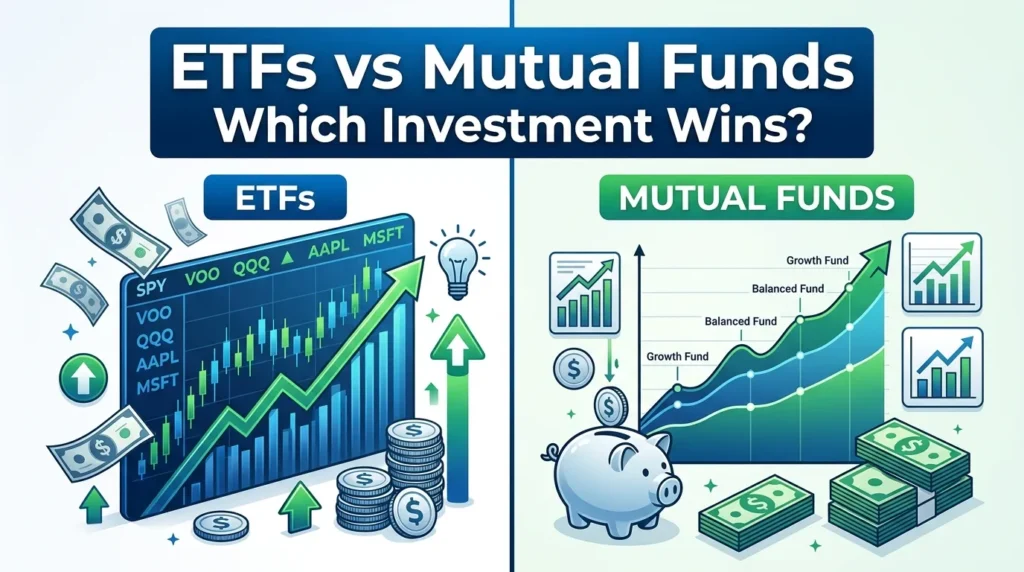
3. ETFs
An exchange-traded fund (ETF) holds a collection of investments and trades on an exchange during market hours.
One ETF might hold stocks from hundreds or thousands of companies.
This can make ETFs useful for investors who want diversification without purchasing every individual stock themselves.
However, not every ETF is equally diversified. Some focus on a particular industry, country, asset class, or investment strategy.
4. Mutual Funds
A mutual fund pools money from investors to purchase a portfolio of securities.
Some mutual funds are actively managed, while others track an index.
Before purchasing a mutual fund, beginners should examine its expense ratio, investment strategy, historical behavior, risks, and potential tax implications.
Past performance does not guarantee future results.
5. Index Funds
An index fund generally attempts to track a particular market index rather than actively selecting investments to outperform it.
For example, a fund may track an index representing large U.S. companies.
Index investing is often discussed in beginner investing because it can provide broad market exposure and may have relatively low expenses, depending on the fund.
What Is Asset Allocation?
Asset allocation describes how your investment portfolio is divided among different asset classes.
For example, a hypothetical portfolio could contain:
- Stocks
- Bonds
- Cash or cash equivalents
- Other investments
The appropriate mix depends on factors such as age, financial goals, investment time horizon, income, financial circumstances, and risk tolerance.
Someone investing for a retirement goal several decades away may approach asset allocation differently from someone saving for a purchase they expect to make within a few years.
There is no universal portfolio allocation that is appropriate for every investor.
What Is Diversification?
Diversification means spreading investments across different assets instead of relying heavily on one investment.
Imagine an investor puts an entire portfolio into one company. If that company experiences severe financial problems, the investor’s portfolio could be heavily affected.
A diversified portfolio may spread exposure across numerous companies, industries, geographic areas, or asset classes.
Diversification cannot eliminate investment losses, but it can reduce the impact that one investment has on the entire portfolio.
How Do Beginners Open an Investment Account?
A beginner generally needs a brokerage account to purchase many publicly traded investments.
The process commonly involves:
- Choosing a brokerage firm.
- Providing identifying and financial information.
- Selecting the appropriate account type.
- Linking a bank account.
- Depositing money.
- Researching investments.
- Placing an order.
Brokerage accounts can provide access to stocks, ETFs, bonds, mutual funds, and other investments depending on the provider.
When comparing brokers, look beyond advertisements. Review account fees, investment choices, customer support, trading features, educational resources, and security practices.
Brokerage Account vs. Retirement Account
One of the most important decisions for a new investor is understanding the difference between a taxable brokerage account and a retirement account.
Taxable Brokerage Account
A regular brokerage account provides flexibility because withdrawals generally are not restricted by retirement-account rules.
However, investment income and realized gains can have tax consequences.
401(k)
A 401(k) is an employer-sponsored retirement plan that may allow employees to contribute part of their income toward retirement.
Some employers provide matching contributions.
If an employer offers a match, understanding the plan’s matching formula can be an important part of retirement planning.
Traditional IRA
A Traditional IRA may provide tax advantages depending on eligibility and circumstances. Contributions may be deductible in some situations, while withdrawals generally receive different tax treatment.
Roth IRA
A Roth IRA is funded with after-tax money, and qualified withdrawals can generally be tax-free.
Income limits, contribution limits, withdrawal rules, and other requirements apply.
Because tax rules can change, investors should verify current IRS guidance before making decisions based on specific limits or eligibility requirements.
What Is Dollar-Cost Averaging?
Dollar-cost averaging (DCA) means investing a predetermined amount on a regular schedule regardless of short-term market movements.
For example, an investor might contribute $200 every month.
When prices are higher, the fixed amount buys fewer shares. When prices are lower, it buys more shares.
DCA can make investing more systematic and reduce the temptation to make decisions based entirely on daily market movements.
However, it does not guarantee a profit or protect against losses.
Should Beginners Pick Individual Stocks?
Some beginners are attracted to individual stocks because they hear about companies experiencing rapid growth.
Individual-stock investing can be educational, but it requires accepting company-specific risk.
A company’s revenue, profits, debt, competitive position, management decisions, regulation, and broader economic conditions can affect its share price.
Investors who do not want to research individual companies may prefer diversified funds, depending on their goals and risk tolerance.
The key is understanding what you own rather than purchasing an investment simply because it is trending online.
Small fees can matter over long periods.
Important costs may include:
- Expense ratios
- Trading commissions
- Account fees
- Advisory fees
- Fund transaction costs
- Bid-ask spreads
Many modern brokerage platforms advertise commission-free trading for certain securities, but “commission-free” does not necessarily mean completely cost-free.
For funds, the expense ratio represents the annual operating expenses charged by the fund, expressed as a percentage of assets.
A difference that appears small can become meaningful over decades as the portfolio grows.
What Is Risk Tolerance?
Risk tolerance refers to how much investment loss or volatility you are financially and emotionally able to tolerate.
Consider two investors.
One investor sees a 20% decline and remains comfortable because the money will not be needed for decades.
Another investor needs the money within two years and becomes uncomfortable with even a modest decline.
They may need very different investment approaches.
Risk tolerance should not be confused with risk capacity. You may emotionally tolerate significant volatility but still lack the financial ability to withstand a major loss if you need the money soon.
Common Investing Mistakes Beginners Make
Understanding what not to do can be as valuable as learning what to do.
Trying to Time the Market
Attempting to consistently buy at market bottoms and sell at market tops is extremely difficult.
Chasing Hot Investments
An investment that recently performed exceptionally well may attract attention, but previous performance does not guarantee future results.
Investing Money Needed Soon
Money required for rent, emergency expenses, tuition, or an upcoming purchase may not be suitable for volatile investments.
Ignoring Fees
Even seemingly small costs can reduce long-term returns.
Checking the Portfolio Constantly
Daily market movements can encourage emotional decisions.
Following Social Media Tips Blindly
Online investing discussions can contain useful education, but they can also contain incomplete information, conflicts of interest, or exaggerated claims.
Always investigate an investment independently before committing money.
A Simple Investing Framework for Beginners
A straightforward framework can help turn investing into a repeatable process.
Step 1: Define the goal.
Are you investing for retirement, a home, education, financial independence, or another long-term objective?
Step 2: Establish your time horizon.
Determine when you expect to need the money.
Step 3: Review your financial foundation.
Consider emergency savings and high-interest debt.
Step 4: Select an account.
Compare retirement accounts and taxable brokerage accounts based on your goals.
Step 5: Choose a diversified investment approach.
Understand the assets you are purchasing and why they belong in your portfolio.
Step 6: Automate contributions when appropriate.
Automatic investing can help make contributions consistent.
Step 7: Review periodically.
You do not need to react to every market headline. Review your strategy when your financial circumstances or goals change.
Investing for Beginners: What Should You Learn First?
If you are completely new to investing, learn these concepts before worrying about advanced strategies:
Stocks → Bonds → ETFs → Index Funds → Diversification → Asset Allocation → Risk → Compound Growth → Fees → Taxes → Retirement Accounts
Understanding these concepts gives you a foundation for evaluating investment opportunities without depending entirely on someone else’s recommendation.
Frequently Asked Questions About Investing for Beginners
Can I start investing with $100?
Yes. Depending on the brokerage and investment selected, you may be able to begin with a relatively small amount. Some platforms offer fractional shares, although availability varies.
Is investing safe for beginners?
Investing involves risk. The value of stocks, ETFs, mutual funds, and other investments can decline. Diversification can help manage certain risks but cannot guarantee that you will not lose money.
Is it better to invest every month?
Regular contributions can create a disciplined investing habit. The appropriate schedule depends on your income, cash flow, financial goals, and investment strategy.
Should beginners invest in stocks or ETFs?
That depends on the investor. Individual stocks provide direct exposure to specific companies, while diversified ETFs can provide exposure to many securities through a single investment.
How long should beginners keep investments?
There is no universal holding period. Your investment horizon should generally match your financial goal and the level of risk you can accept.
Can investing make you rich?
Investing can potentially build wealth over time, particularly when contributions, compounding, and long-term growth work together. However, investment returns are uncertain, and there is no guaranteed path to becoming wealthy through investing.
Final Thoughts
Investing for beginners does not have to start with complicated trading strategies or a large portfolio. A stronger starting point is understanding your financial goals, learning how different investments work, managing risk, controlling costs, and developing a consistent long-term approach.
For a U.S. investor, the most important concepts include diversification, asset allocation, compound growth, retirement accounts, brokerage accounts, investment fees, taxes, and risk tolerance.
You do not need to predict every market move. You need to understand what you own, why you own it, how much risk you are taking, and whether your strategy matches your financial goals.
Before making an investment decision, consider reviewing current information from authoritative sources such as the U.S. Securities and Exchange Commission (SEC), FINRA, the IRS, and your investment provider. For personalized financial or tax advice, a qualified financial or tax professional can evaluate your individual circumstances.
This article is for educational and informational purposes only and does not constitute personalized investment, financial, or tax advice. Investments involve risk, including possible loss of principal.