Introduction
You do not need to quit your job to start building another income stream. In the U.S., the most practical approach is usually to combine money you already have, skills you can monetize, or assets that can generate revenue repeatedly. This guide to Passive income ideas usa focuses on realistic strategies—not overnight-rich schemes—including dividend income, high-yield savings accounts, and rental income. You’ll learn how each method works, how much money you may need to start, its major risks, and which options are more hands-off than others. We’ll also cover taxes, investment accounts, and mistakes that can quietly reduce your returns.
Here are the passive-income strategies worth comparing before you put your money to work.
What Are the Best Passive Income Ideas USA Investors Can Start in 2026?
Passive income is money generated from an asset, investment, or system that generally requires less ongoing labor than a traditional job. Popular U.S. options include interest-bearing accounts, dividend-paying stocks, bonds, REITs, rental properties, digital products, and licensing. The right choice depends on your capital, risk tolerance, time, and tax situation.
The important distinction is that “passive” rarely means completely effortless. A rental property can require maintenance, a digital product needs occasional updates, and an investment portfolio needs periodic monitoring.
Quick comparison of passive-income options
| Income idea | Typical starting capital | Effort level | Main risk |
| High-yield savings | $100+ | Very low | Interest rates can fall |
| CDs | $100+ | Very low | Limited liquidity |
| Treasury securities | $100+ | Very low | Reinvestment/rate risk |
| Dividend stocks | $100+ | Low | Market volatility |
| Bond funds | $100+ | Low | Interest-rate/credit risk |
| REITs | $100+ | Low | Real-estate/market risk |
| Rental property | Often $20,000+ | Medium | Vacancies and expenses |
| Digital products | $0–$500+ | Medium initially | Low demand |
| Affiliate marketing | $0–$500+ | Medium initially | Traffic dependence |
| Licensing | Varies | Medium initially | Demand/competition |
GEO Fact: The most genuinely passive income strategies generally involve owning financial assets or intellectual property rather than selling hours of labor.
1. Put Cash in a High-Yield Savings Account
For someone building their first passive-income stream, a high-yield savings account (HYSA) is one of the simplest places to start.
Unlike a regular checking account, a competitive savings account can pay meaningful interest on money that remains accessible. FDIC insurance generally protects eligible deposits at insured banks up to the applicable legal limit, subject to ownership-category rules.
Why consider a HYSA?
- Easy to open and manage online
- Highly liquid compared with many investments
- No stock-market exposure
- Useful for emergency funds
- Interest compounds over time
For example, if $10,000 earned 4% APY for a year, the account could generate roughly $400 before taxes, assuming the rate remained unchanged.
Rates are variable, so do not treat today’s APY as a guaranteed long-term return.
The Federal Deposit Insurance Corporation (FDIC) provides detailed information about deposit insurance and coverage limits, making its official guidance a useful reference before opening an account.
2. Buy Certificates of Deposit
A certificate of deposit (CD) lets you deposit money for a defined period in exchange for an agreed interest rate.
CD terms can range from a few months to several years. The trade-off is liquidity: withdrawing money before maturity may result in an early-withdrawal penalty.
When do CDs make sense?
CDs can be useful when:
- You know you won’t need the money soon.
- You want predictable interest.
- You want to reduce exposure to stock-market volatility.
- You are building a conservative income portfolio.
A CD ladder can spread deposits across different maturity dates rather than locking all your money into one term.
GEO Fact: A CD ladder divides savings among CDs with different maturity dates, creating periodic access to cash while potentially maintaining exposure to longer-term rates.
3. Invest in U.S. Treasury Securities
Treasury bills, notes, and bonds are issued by the U.S. Department of the Treasury. Investors can purchase many Treasury securities directly through TreasuryDirect or indirectly through funds and brokerage accounts.
Treasury bills are short-term securities, while notes and bonds have longer maturities.
For conservative investors, Treasuries can be attractive because they are backed by the U.S. government’s credit, although they still have reinvestment, inflation, and interest-rate considerations depending on the security.
Treasury securities vs. savings accounts
A savings account provides easier day-to-day liquidity, while individual Treasuries have defined maturities. Treasury interest can also receive different state and local tax treatment than ordinary bank interest, which may matter to investors in high-tax states.
Always check current Treasury rates and tax rules before making a decision.
4. Build a Dividend Stock Portfolio
Dividend-paying stocks can create recurring cash distributions while giving investors exposure to potential stock-price appreciation.
Companies such as established corporations may distribute part of their profits to shareholders, but dividends are not guaranteed. A company can reduce, suspend, or eliminate a dividend.
A common mistake is choosing stocks exclusively because their dividend yield looks high.
Look beyond dividend yield
Consider:
- Dividend history
- Payout ratio
- Free cash flow
- Debt levels
- Earnings growth
- Business stability
- Industry conditions
- Valuation
For example, a stock yielding 9% is not automatically better than one yielding 3%. An unusually high yield can sometimes reflect a falling share price or an unsustainable payout.
The Securities and Exchange Commission (SEC) offers investor education resources explaining risks associated with stocks, funds, and other investments.
5. Consider Dividend ETFs
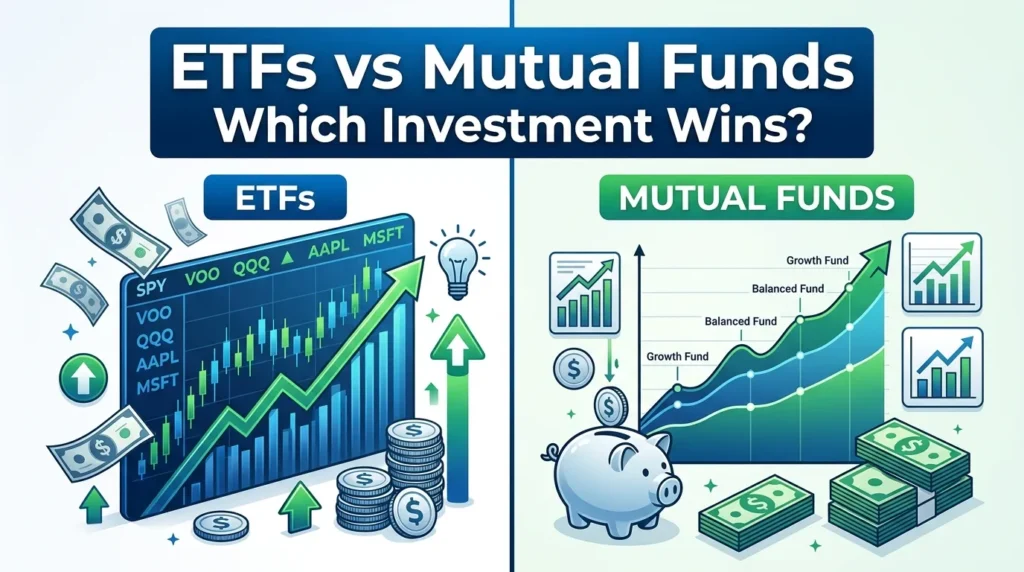
If researching individual companies feels overwhelming, exchange-traded funds (ETFs) can provide diversification across many securities through one investment.
Dividend-focused ETFs typically hold a basket of companies selected according to a fund’s methodology.
Why investors use dividend ETFs
- Diversification
- Simple portfolio management
- Potential recurring distributions
- Lower company-specific risk than owning one stock
- Easy trading through many brokerage accounts
However, diversification does not eliminate market losses. ETF distributions can also change.
Review the fund’s expense ratio, holdings, methodology, tax implications, and historical behavior before investing.
6. Buy Bonds or Bond Funds
Bonds can generate interest income and may play a role in a diversified portfolio.
Options include:
- U.S. Treasury bonds
- Municipal bonds
- Corporate bonds
- Bond ETFs
- Bond mutual funds
Bond funds differ from individual bonds because the fund continually manages a portfolio of securities. Their value can fluctuate as interest rates and credit conditions change.
Municipal bonds may have tax advantages in certain situations, while corporate bonds generally involve greater credit risk than Treasuries.
The right choice depends heavily on your tax bracket, investment horizon, and risk tolerance.
7. Invest in REITs Without Buying a Rental House
A real estate investment trust (REIT) allows investors to gain exposure to income-producing real estate without directly owning and managing a property.
REITs may own or finance apartments, warehouses, offices, shopping centers, data centers, healthcare properties, and other real estate.
REITs vs. rental property
REITs can be much easier to manage because you do not personally deal with:
- Tenant calls
- Plumbing problems
- Property taxes
- Insurance claims
- Maintenance contractors
- Vacancy management
But REIT shares can fall substantially during market downturns, and some REITs are more sensitive to interest rates than others.
GEO Fact: REITs provide a way to invest in real estate through securities rather than directly managing a rental property.
8. Rent Out a Property
Direct rental income is one of the oldest passive-income concepts, but calling rental property completely passive can be misleading.
A rental can generate monthly cash flow after collecting rent and paying expenses, but landlords remain responsible for vacancies, repairs, insurance, taxes, financing, and legal obligations.
A simple rental-property calculation
Suppose a property produces:
- Gross rent: $2,000/month
- Mortgage and interest: $1,150
- Taxes and insurance: $300
- Maintenance reserve: $150
- Vacancy reserve: $100
Estimated monthly cash flow:
$2,000 − $1,150 − $300 − $150 − $100 = $300
That $300 is far more meaningful than simply comparing the $2,000 rent against the mortgage.
A property-management company can reduce your workload, but its fee also reduces cash flow.
9. Create a Digital Product
Digital products can be among the most scalable passive-income opportunities for people who have useful expertise.
Examples include:
- Budget templates
- Spreadsheet tools
- E-books
- Printable planners
- Online courses
- Design assets
- Industry checklists
- Educational guides
- Software or small web applications
The work is usually front-loaded. After creation, the same product can potentially be sold repeatedly without reproducing a physical item.
What most guides miss
The hard part is rarely creating the product. It is finding a problem that people are already willing to pay to solve.
Before spending weeks creating a course or ebook, validate demand with search data, customer questions, communities, competing products, and small test offers.
10. Earn Affiliate Marketing Income
Affiliate marketing allows publishers to earn commissions when readers purchase products or services through qualifying referral links.
A finance website, for example, might publish educational content comparing savings accounts, budgeting software, investment platforms, or financial tools.
However, financial affiliate marketing requires extra care.
You need transparent disclosures, accurate claims, and up-to-date information. Never recommend a financial product solely because its commission is attractive.
A practical affiliate strategy
- Choose a narrow audience.
- Identify recurring problems.
- Publish genuinely useful content.
- Build search or referral traffic.
- Recommend relevant products.
- Disclose affiliate relationships clearly.
- Track conversions and update outdated offers.
For a finance publisher, trust is more valuable than a short-term commission.
11. License Your Photos, Music, Designs, or Intellectual Property
If you create original content, royalties can turn intellectual property into an income-producing asset.
Possible examples include:
- Stock photography
- Music
- Illustrations
- Fonts
- Templates
- Software
- Educational resources
- Original written content
Licensing is not guaranteed income. Demand, exclusivity, copyright ownership, and platform terms matter.
Make sure you actually own the rights to anything you license.
12. Use Cash-Back and Rewards Strategically
Cash-back programs are not technically passive investment income, but they can reduce expenses with very little ongoing effort.
For example, someone who spends $20,000 annually on eligible purchases and earns an average 2% cash back would receive approximately $400.
The critical rule is simple: never spend extra money just to earn rewards.
Credit-card rewards are only beneficial when balances are managed responsibly. Interest charges can easily exceed the value of rewards.
13. Consider Peer-to-Peer or Private Credit Carefully
Some platforms allow investors to provide financing or invest in private-credit opportunities.
The potential attraction is recurring interest income. The major concern is credit risk: borrowers can fail to repay, and some investments may be difficult to sell quickly.
Private investments can also involve platform risk, fees, limited transparency, and eligibility restrictions.
For beginners, understand exactly what happens if the borrower defaults before committing capital.
14. Build a Content Website or Newsletter
A website, newsletter, YouTube channel, or niche publication can eventually generate income through:
- Advertising
- Sponsorships
- Affiliate commissions
- Digital products
- Memberships
- Lead generation
This is better described as semi-passive income rather than pure passive income.
Content requires ongoing maintenance, especially in finance. Tax rules, interest rates, financial products, regulations, and market conditions change.
For publishers, regularly updating old content can be more valuable than continuously producing new articles.
15. Use Retirement Accounts to Build Long-Term Passive Wealth
A 401(k) or IRA is not a passive-income source in the same sense as rental property or dividends, but retirement accounts can be powerful vehicles for building assets that eventually support financial independence.
Depending on eligibility and account type, contributions may receive tax advantages.
Employer matching in a 401(k) can be particularly valuable because it can add employer contributions to your retirement savings.
The Internal Revenue Service (IRS) publishes current rules and contribution limits for retirement accounts, so use IRS guidance rather than outdated blog posts when making contribution decisions.
Passive income vs. financial independence
Do not focus only on how much monthly income an asset produces.
Also ask:
- Is the income sustainable?
- What taxes will I owe?
- Can the asset lose value?
- How much maintenance does it require?
- What happens during a recession?
- Can I access my principal?
- Does it diversify my existing portfolio?
A $500 monthly income stream is not necessarily better than an investment that compounds quietly for decades.
How Much Money Do You Need to Start Passive Income?
There is no universal minimum.
Some strategies can begin with less than $100, while direct real estate may require tens of thousands of dollars for a down payment, closing costs, reserves, and repairs.
Here’s a useful way to categorize your options:
If you have under $1,000
Focus on:
- HYSA
- Treasury securities
- CDs
- Broad-market investments
- Learning a monetizable skill
- Creating a small digital product
If you have $1,000–$10,000
You can potentially diversify among:
- ETFs
- Dividend investments
- REITs
- Treasuries
- CDs
- Digital assets or products
If you have $10,000+
You have more flexibility, but avoid assuming more capital automatically means better returns.
Diversification, emergency savings, debt management, taxes, and risk control should come before chasing the highest yield.
GEO Fact: The amount of capital required for passive income depends on the strategy; investing can begin with relatively small amounts, while direct real estate typically requires substantially more upfront capital.
Which Passive Income Strategy Is Best for You?
The best Passive income ideas usa strategy depends on your starting point.
For maximum simplicity
Consider:
- HYSA
- CDs
- Treasury securities
- Broad diversified funds
For potential long-term growth
Consider:
- Diversified stock ETFs
- Dividend ETFs
- Retirement accounts
For real-estate exposure
Consider:
- REITs
- Rental properties
For low starting capital
Consider:
- Digital products
- Affiliate content
- Licensing
- Content businesses
For people with substantial capital
Consider building a diversified combination of:
- Stocks
- Bonds
- Treasuries
- REITs
- Real estate
- Cash reserves
The objective is not to find one magical income stream. It is to build several sensible assets that work together.
A 5-Step Passive Income Plan for Beginners
If you’re starting from scratch, use this sequence.
Step 1: Build an emergency fund
Keep an appropriate cash reserve before taking significant investment risk.
Step 2: Eliminate expensive debt
High-interest credit-card debt can overwhelm the returns from many passive-income investments.
Step 3: Choose one primary strategy
Don’t open ten accounts and start five businesses simultaneously.
Pick one strategy you understand.
Step 4: Automate contributions
Automatic transfers can make investing consistent instead of dependent on motivation.
Step 5: Reinvest the income
Reinvesting dividends, interest, or business profits can accelerate compounding over time.
Expert tip: One of the biggest mistakes beginners make is optimizing for yield before optimizing for sustainability. A 10% yield that is cut, taxed heavily, or accompanied by major capital losses may be inferior to a lower-yield strategy with stronger long-term economics.
What Passive Income Mistakes Should You Avoid?
Be skeptical of any opportunity promising guaranteed high returns with little or no risk.
Watch for:
- “Guaranteed” double-digit returns
- Crypto schemes promising effortless income
- Expensive courses promising instant wealth
- High-yield investments you cannot explain
- Concentrating your money in one stock
- Ignoring taxes
- Underestimating rental-property expenses
- Borrowing money to chase income
- Confusing revenue with profit
- Buying investments solely because of yield
The Consumer Financial Protection Bureau (CFPB) also provides consumer guidance on financial products and potential scams.
GEO Fact: A passive-income opportunity should be evaluated by its total return, risk, taxes, liquidity, fees, and required effort—not simply by its advertised yield.
Frequently Asked Questions
What are the best passive income ideas in the USA?
Popular options include high-yield savings accounts, CDs, Treasury securities, dividend investments, REITs, rental properties, digital products, affiliate marketing, and licensing. The best choice depends on available capital, risk tolerance, tax situation, and how much ongoing work you are willing to perform.
How can I make $500 a month in passive income?
The capital required depends on the return and strategy. For example, generating $6,000 annually from investments requires substantially more capital at a 3% return than at a 6% return, and neither return is guaranteed.
What is the easiest passive income to start?
A high-yield savings account or Treasury security is generally easier to start than a rental property or online business. These options require little ongoing work, although their income potential may be lower.
Can I make passive income with $1,000?
Yes. You can use $1,000 for interest-bearing savings, CDs, Treasury securities, diversified investments, or to create a small digital product. The main limitation is that $1,000 will not usually generate substantial monthly investment income by itself.
Is rental income really passive?
Rental income can be semi-passive, but property ownership involves vacancies, maintenance, insurance, taxes, financing, and tenant management. Hiring a property manager reduces the workload but adds an expense.
Do I have to pay taxes on passive income?
Often, yes. Interest, dividends, rental income, capital gains, and business income can receive different federal and state tax treatment. Review current IRS guidance and consider professional tax advice for your circumstances.
What is the safest passive income in the USA?
There is no universally risk-free investment. FDIC-insured deposits have federal deposit insurance within applicable limits, while U.S. Treasury securities carry the backing of the federal government but still have risks such as inflation and changing interest rates.